

Cegedim Romania published in March this year the 7th edition of the newsletter intended for all family doctors working with the Pharmec Cabinet™ application. This newsletter aims to bring to the forefront summary information relevant to their activity, in order to always be up to date with the evolution of the main aspects of interest for family medicine.
The information is obtained from a sample of family physicians working with Pharmec Cabinet™ and processed within the partnership with Cegedim Health Data, in order to obtain anonymized data from current medical practice (Real-World Data) and to conduct research studies based on real world evidence (Real-World Evidence). These boost medical research and significantly improve the condition of patients, in the interest of public health. Data collection and processing of is done by anonymization at the source level, in accordance with the provisions of the GDPR regarding the physicians’ or patients’ identity.
The data was also analyzed together with other information from various publicly available sources and mentioned separately, where applicable.
Trends in family medicine: topics of interest in the 2026 edition
The 2026 edition of this newsletter provides an overview of the activity of family doctors throughout 2025. The analyzed information refers to various aspects related to patients and their pathologies, grouped as follows:
- Synthetic indicators about the activity of doctors between 2020-2025:
- Volume and accessibility of services
- Clinical activity
- Prescribing activity
- General information about patients’ profile
- Evolution of the number of patients and the main pathologies analyzed in terms of prevalence and incidence
Family doctors’ activity: main indicators between 2020 – 2025
Volume and access to services indications
The main indicators of volume and access to medical services did not undergo significant changes between 2020 and 2025 (no. of patients in family doctor records, no. of patients registered per family doctor, no. of consultations per patient in a year, etc.). The only indicator that experienced a significant evolution during this period is the total number of consultations and services provided per year (compound annual growth of 22.4%).
Also, the number of family doctors under contract with CNAS has steadily decreased in recent years, reaching from 10 452 in 2020 to 10 062 in 2024.
Clinical activity indicators
Regarding clinical activity indicators between 2020 – 2025, we note that the number of patients visiting their family doctors at least once a year gradually returned to pre-pandemic levels, despite a fairly significant decrease in 2021. The percentage of new patients and diagnoses remained fairly constant, fluctuating between 12% and 14%.
The proportion of patients referred to outpatient or inpatient services increased from 31% during the pandemic to 44% by 2025. Referrals for paraclinical investigations also increased, from 17% to 24% of total patients, from the pandemic to 2025.
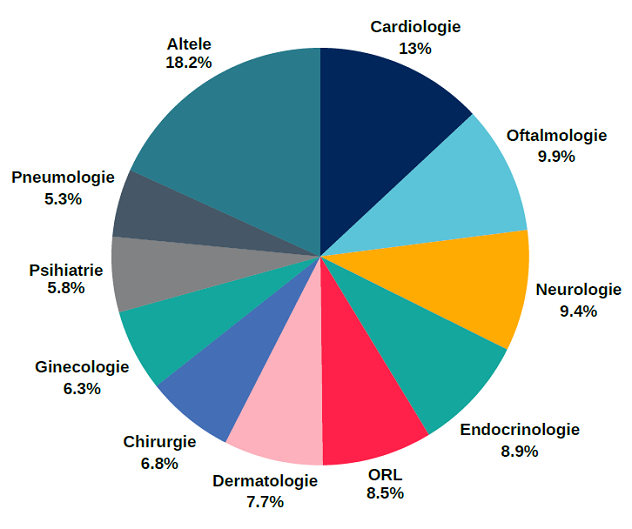
As it can be seen from the graph below, the top 10 medical specialties to which family doctors have issued referrals in recent years generate approximately 82% of the total number of referrals:
The rate of vaccinations administered by family doctors has decreased from 11% of total patients in 2020 and has stabilized around 6% in recent years, without additional measures.
Indicators regarding prescribing activity
The number of prescriptions dispensed per patient per year fluctuates around 14 prescriptions/year (both compensated and non-compensated), corresponding to an approximate total of 46-48 units prescribed per patient per year. The average number of prescriptions dispensed annually by family doctors increased from 6 255 in 2020 to approximately 7 000 in 2025, representing a compound annual growth rate (CAGR) of 2%, while the number of compensated prescriptions increased by 6.6% CAGR.
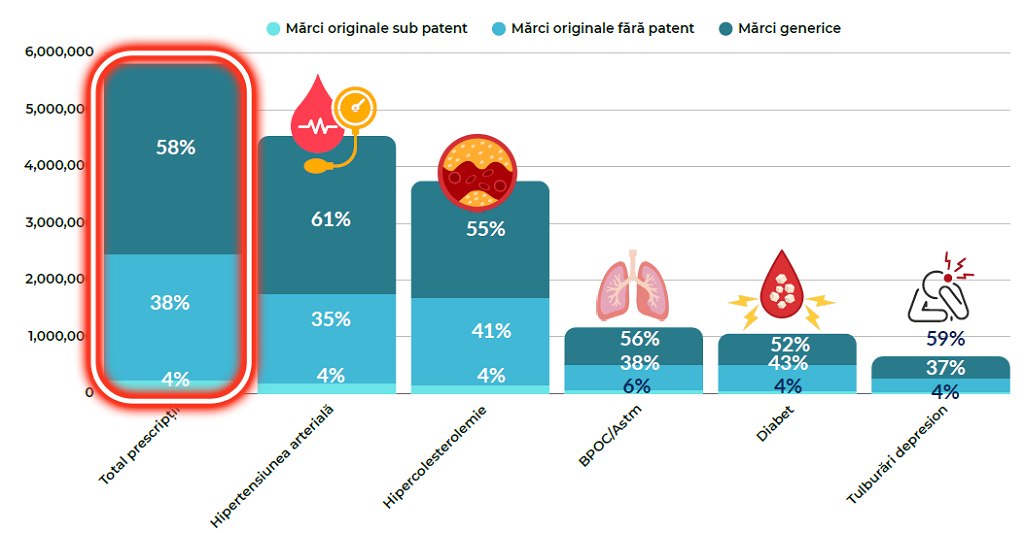
Although prescribing medicines using the international non-proprietary name (INN) is mandatory, family doctors often prefer generic or original brands. This preference can be analyzed according to pathology, therapeutic class or INN. Overall, 4% of prescriptions contain an original brand under patent, 38% an original brand without patent, and more than half include a generic drug. Small variations are observed within the same category for pathologies such as hypertension, hypercholesterolemia, COPD, asthma, diabetes or depression. Volume analysis confirms the same structure.
General information about patient profiles – family medicine
The main age groups of patients include people in their 50s, 60s and 70s, as well as younger groups such as children and adolescents. The mean and median age of patients is 49 years.
Approximately 25% of patients maintained a relationship with their family doctor for 10 years or more, while 28% had a relationship that lasted between 5 and 10 years. The average duration of these relationships is 5.78 years, with a median of 5.19 years.
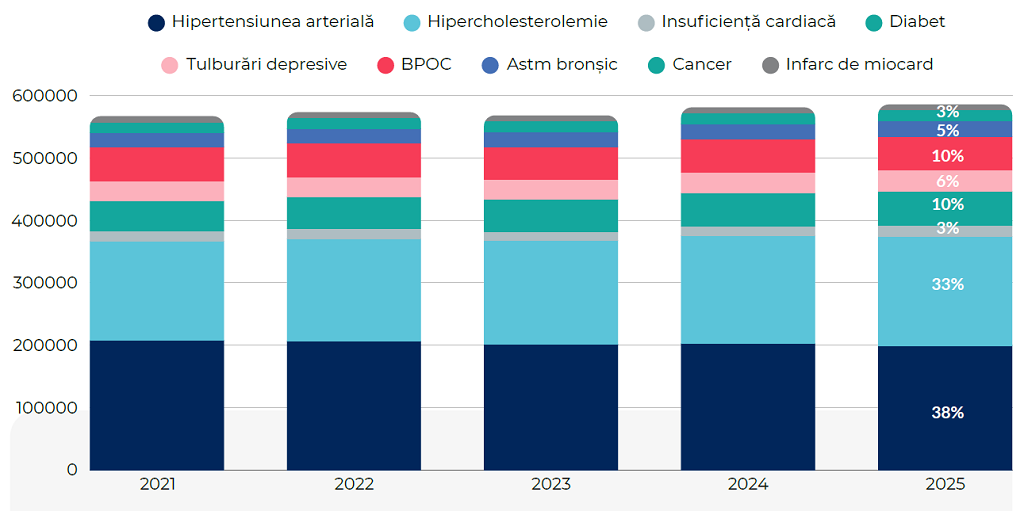
Top chronic conditions in the family doctor’s records: annual developments by number of patients
Cardiovascular diseases affect approx. 38% of patients treated by family doctors, followed by dyslipidemia (33%) and diabetes and COPD (10%).
In order to find out more details about aspects such as patients’ profiles or the prevalence and incidence of the main pathologies in the family doctor’s records, we invite you to consult the newsletter produced by Cegedim Health Data.
For any further details or questions, please contact us using the contact form.